Tag: UAE real estate

  • Dubai Property Buyers Show Strong Intent Despite Price Correction Expectations

    Dubai’s property market is witnessing a paradox of strategic confidence: buyers are not retreating as prices soften — they are positioning themselves to act. Property Finder’s March-April 2026 Market Pulse survey of 4,735 respondents shows that 68% of active property seekers intend to purchase within the next six months, even as expectations of price corrections reach their highest level this year.

    The findings reflect a market where demand remains robust, but buyers have become acutely aware of shifting valuations. Buying intent held steady across both months — 68% in March and 67% in April — continuing a pattern of sustained engagement across every Market Pulse edition to date. This consistency underscores long-term confidence in the emirate’s real estate fundamentals, even during periods of price recalibration.

    The more striking shift lies in price expectations. In January-February 2026, sentiment was almost evenly split: 36% expected prices to decrease, 35% anticipated increases, and 29% saw stability ahead. By March-April, that uncertainty had crystallized into a clear consensus. In March, 73% of respondents expected prices to decrease, with only 16% expecting an increase and 11% expecting stability. In April, 70% anticipated a decline, 17% an increase, and 12% stability.

    “Around two thirds of people planning to buy is not a number you see in a market that has lost confidence,” said Cherif Sleiman, Chief Revenue Officer at Property Finder. “What our findings tell us is that Dubai’s property market continues to command genuine, forward-looking conviction. Buyers are not on the fence, they are actively tracking conditions, waiting for the right moment, and ready to move.”

    The alignment between buyer expectations and observed market behavior suggests heightened market literacy among investors. The shift in sentiment coincides with measured pricing adjustments tracked across multiple platforms, indicating that prospective buyers are monitoring data closely and preparing to capitalize on improved affordability.

    This proactive outlook positions the broader sector for a robust period of deal-making as expectations align with real-world price corrections. Rather than signaling retreat, the data reveals a market where purchase demand is holding strong, supported by buyers who see price moderation not as a deterrent, but as an entry point. The trend reflects sustained belief in Dubai’s property infrastructure and long-term appeal, particularly as the emirate continues to attract global capital despite regional geopolitical uncertainty.

    As Dubai’s real estate market enters the summer period, the combination of strategic buyer intent and disciplined price expectations suggests a sector transitioning from peak momentum to calibrated growth — a development that may ultimately reinforce the market’s resilience and maturity as a global investment destination.

  • Emaar Properties Records Dh22.4 Billion in Q1 2026 Sales

    Emaar Properties Records Dh22.4 Billion in Q1 2026 Sales

    Dubai’s leading real estate developer demonstrated robust performance in Q1 2026, with total revenue reaching Dh12.4 billion—a 23% jump compared to the same period in 2025. The growth was supported by strong contributions from both UAE and international operations.

    Emaar’s subsidiary, Emaar Development, recorded property sales of Dh20.1 billion during the quarter, representing a 22% increase year-on-year. The company’s net profit climbed to just under Dh3.5 billion, a 36% surge from Q1 2025.

    As of March 31, 2026, Emaar’s revenue backlog stood at approximately Dh163.4 billion, reflecting a 29% annual increase and providing strong revenue visibility for the coming years. Emaar Development’s backlog reached Dh134.6 billion, up 35% from the prior year.

    “Our performance in the first quarter of 2026 reflects the strength and resilience of the UAE economy, which continues to provide a stable foundation despite broader regional volatility,” said Mohamed Alabbar, founder of Emaar.

    Alabbar emphasized that recent geopolitical developments have reinforced the UAE’s position as a market defined by safety, institutional continuity, and long-term vision. “The UAE’s stability is the result of decades of wise leadership, sustained investment in world-class infrastructure, and a clear, business-friendly policy environment,” he added.

    Despite regional tensions affecting the quarter’s final weeks, Emaar Development maintained construction schedules across all ongoing projects. The company launched 10 new residential projects across its master-planned communities in response to evolving market demand.

    The developer recently distributed a dividend equivalent to 100% of its share capital to shareholders, amounting to Dh8.9 billion—marking the second consecutive year of such a payout.

    Emaar’s Q1 performance aligns with broader market trends showing Dubai’s property sector resilience, as the emirate’s real estate market continues to attract sustained investor interest. The company’s strong backlog and project pipeline position it well to capitalize on Dubai’s robust Q1 market activity, which saw total transactions exceed Dh180 billion across the emirate.

  • Abu Dhabi Property Prices Jump 6.4% in Q1 2026

    The capital’s residential sector sustained its positive momentum through the first quarter of 2026, with capital values showing faster growth compared to the prior quarter, according to ValuStrat’s latest market report published on May 8, 2026.

    The ValuStrat Price Index (VPI) for Abu Dhabi’s freehold residential properties climbed to 148 points in Q1 2026, reflecting a 6.4% quarter-on-quarter increase and a robust 17.8% year-on-year rise—clear signs of acceleration from the previous period.

    Apartments drove the surge, with values up 10.4% quarter-on-quarter and 22.7% year-on-year, while villas saw steadier advances of 2.7% quarterly and 13.4% annually. Strongest results appeared in mature communities offering immediate inventory availability.

    The analysis attributes this momentum partly to Abu Dhabi’s more advanced stage in the real estate cycle relative to Dubai, combined with relatively affordable pricing that keeps attracting end-user buyers. This resilience holds firm even amid a regionally uncertain environment.

    “While geopolitical tensions have sparked some caution across the UAE, no substantial effects on Abu Dhabi’s property market have emerged so far,” ValuStrat noted in the report.

    Supply dynamics further bolstered prices, with controlled delivery rates keeping conditions favorable. Transaction activity during the quarter likely faced headwinds from seasonal elements like Ramadan and Eid celebrations, plus remote work trends, homeschooling, and unfavorable weather.

    Rental trends stayed even-keeled, with the residential rental VPI holding steady quarter-on-quarter at 128.1 points but advancing 5.9% annually. Consistent rents paired with 88.1% occupancy underscore a balanced leasing landscape.

    The report describes Abu Dhabi’s office sector as solid, with listing sales prices and rents posting both quarterly and yearly gains, fueled by high occupancy. The industrial market also held steady, showing flat quarterly prices alongside double-digit annual growth, while rents kept rising in most areas.

    Given the UAE’s real estate dynamics, Abu Dhabi and Dubai don’t always sync perfectly, but they typically align on overarching trends over longer periods. Consequently, any lasting changes in market dynamics could take time to fully reach the capital, according to the ValuStrat analysis.

    The capital’s performance mirrors broader regional strength, with transaction volumes rebounding in April and the emirate posting its second-strongest quarter on record earlier this year.

  • Abu Dhabi Residential Market Posts Second-Strongest Quarter on Record

    Abu Dhabi Residential Market Posts Second-Strongest Quarter on Record

    The capital’s property sector maintained robust momentum through January and February before moderating in March as regional geopolitical tensions, Ramadan observance, and school holidays influenced activity levels.

    Off-plan sales continued to dominate the market in Q1 2026, accounting for 81 percent of all transactions, up from 80 percent in Q4 2025. Demand was supported by major launches, including Manchester City Yas Residences by Ohana Development, which generated AED6 billion in sales within 72 hours.

    Apartment activity reached unprecedented levels, with a record 5,200 apartment transactions in the quarter, representing 73 percent of all sales, up from 67 percent in 2025. This marked the third consecutive quarter with apartment volumes above 4,000.

    Average sales rates across Abu Dhabi increased sharply during the period. Off-plan rates rose 39 percent quarter-on-quarter, from AED16,540 per square meter at the end of 2025 to AED23,067 per square meter in Q1 2026. The ready market also improved, with average rates rising 2.66 percent to AED15,480 from AED15,087 in Q4 2025.

    “The market showed remarkable resilience, delivering near-record transaction volumes in Q1 despite regional geopolitical developments and seasonal factors,” said Ali Ishaq, Head of Residential Agency Abu Dhabi at Savills Middle East.

    March showed a shift in off-plan market composition, with resale off-plan transactions rising from 4 percent to 15 percent of total activity, indicating growing investor-led activity and reassignment transactions. Monthly transaction volumes in March declined 16 percent month-on-month, though reporting lags may not fully capture underlying trends.

    Developer confidence remained strong in Q1, with approximately 20 projects launching around 4,000 units, 80 percent of which were apartments, compared with 3,400 units launched in Q4 2025. Modon Properties launched Tara Park on Al Reem Island in March, demonstrating resilience despite the uncertain backdrop.

    Key completions during the quarter included Fay Al Reeman Phase 2 and The Gate Residence in Masdar City. Q1 2026 accounted for 35 percent of full-year 2025 transaction volumes, underlining the sustained depth of demand across the market.

    Ishaq noted that underlying demand fundamentals remain intact, with supply constraints, limited near-term handovers, and continued investment in major infrastructure and cultural assets supporting a strong medium-term market case.

    The emirate’s broader growth story, supported by ADGM’s expansion, new cultural attractions on Saadiyat Island, and the opening of Disneyland Abu Dhabi, is expected to keep driving wealth migration and prime market demand over the medium term. The UAE’s ultra-wealthy population growth continues to underpin luxury residential demand across the capital.

    Savills cautioned that headline figures should be read with consideration, as transaction data, especially in March, may reflect deals initiated in January and February and may not yet fully capture current market conditions shaped by regional developments.

  • UAE Ultra-Wealthy Population Set to Surge 36% by 2031

    UAE Ultra-Wealthy Population Set to Surge 36% by 2031

    The UAE continues to cement its position as a global magnet for ultra-wealthy individuals, with Knight Frank forecasting a 36% increase in residents holding more than $30 million in assets over the next five years. The growth trajectory places the Emirates among the world’s fastest-expanding markets for high-net-worth individuals, driven by the country’s business-friendly environment and resilient real estate sector.

    Dubai’s luxury property market demonstrated exceptional strength, recording a 25.1% price increase in prime residential properties over the past year and a remarkable 193.9% surge over five years. The emirate secured second place worldwide for prime residential property price growth, reinforcing its appeal to international investors.

    Transaction activity in the ultra-luxury segment has accelerated sharply. Properties valued above $10 million witnessed a dramatic rise from 113 deals in 2021 to 500 transactions in 2025, reflecting sustained appetite for high-end assets despite global economic uncertainties.

    The UAE’s appeal as a business hub and the sustained strength of its real estate sector continue to attract high-net-worth individuals globally.

    The broader Middle East region recorded an average 9.4% increase in prime property prices during 2025, with Dubai’s performance serving as the primary catalyst. The city has emerged as a preferred destination in global wealth migration, often chosen over traditional centres such as New York and London for its stability, connectivity, and favorable business conditions.

    Abu Dhabi has gained momentum as a complementary investment destination, attracting international buyers through its expanding financial ecosystem and cultural institutions including the Louvre Abu Dhabi and the planned Guggenheim Abu Dhabi.

    The sustained influx of ultra-wealthy residents is expected to further stimulate demand across Dubai’s luxury property market, particularly in waterfront developments and prime locations. The trend aligns with broader patterns observed in the UAE’s residential sector, where buyer confidence has remained robust despite regional geopolitical challenges.

    Knight Frank’s forecast underscores the UAE’s transformation into a premier wealth hub, supported by investor-friendly policies, tax advantages, and world-class infrastructure that continue to differentiate the Emirates in an increasingly competitive global landscape.

  • Dubai Property Conversions Triple After Ceasefire Announcement

    Dubai Property Conversions Triple After Ceasefire Announcement

    Dubai’s real estate sector is experiencing a sharp rebound in buyer activity following the ceasefire announcement, with Sobha Realty witnessing customer conversions increase threefold compared to the period before tensions subsided.

    Francis Alfred, managing director of Sobha Realty, told Khaleej Times on April 19, 2026, that the recovery has been immediate and decisive.

    “People who were waiting on the sidelines are beginning to return. International buyers are also coming back,” Alfred said, adding that long-term investors in Dubai remain focused on the emirate’s future prospects rather than short-term geopolitical events.

    The developer, which has delivered 13 master communities in Dubai, is now expanding into Abu Dhabi with its first major project in the capital, bringing the same expertise and customer-focused approach that has defined its operations in Dubai.

    “We have gained deep insights into what customers need and how to deliver high-quality products. We are taking that expertise into Abu Dhabi,” Alfred explained, confirming that the company plans further expansion beyond its debut development in the emirate.

    Quality Over Discounts

    Sobha Realty is maintaining its focus on product quality rather than offering deep discounts to stimulate demand. Alfred emphasized that the company believes in preserving intrinsic value through disciplined pricing.

    “We believe a quality product has intrinsic value. We are not going to discount our projects in a way that reduces that value,” he stated.

    Instead, the developer may offer limited incentives such as support with registration costs while maintaining overall pricing discipline.

    The company’s financial position remains robust, supported by a large land bank, infrastructure assets, and a multi-year revenue backlog from previous sales. Construction funding is largely covered through escrow accounts and customer collections, reducing reliance on additional borrowing.

    “The land is already paid for, and most construction is funded through escrow accounts. We do not foresee any serious requirement for additional funding at this stage,” Alfred confirmed.

    Market Maturity and Resilience

    Alfred noted that the current environment is likely to widen the gap between established developers with proven track records and smaller players with weaker financial foundations. Buyers are increasingly choosing companies with strong reputations and the ability to maintain quality standards.

    “Customers know that trusted developers will deliver the same quality product without compromise,” he said.

    Comparing the current situation with the Covid-19 pandemic, Alfred highlighted that today’s challenges are regional rather than global, meaning the impact on the UAE market should be more contained. He expects the market to return quickly to its previous growth trajectory without experiencing a sharp correction or speculative rally.

    “The UAE property market is now far more mature and resilient. It is not jumping up and down because of short-term events,” Alfred concluded.

    The comments align with broader market trends, as Dubai’s property market staged a sharp recovery in recent weeks despite ongoing volatility in financial markets. The sector recorded Dh32.2 billion in rental contracts during the first quarter of 2026, reflecting sustained stability across residential segments.

  • Modon Unveils Final Phase of Tara Park on Reem Island

    Modon Unveils Final Phase of Tara Park on Reem Island

    The final phase of Tara Park marks the completion of Modon’s residential project on one of Abu Dhabi’s most connected islands. Strategically positioned near two main access bridges, the development offers direct connectivity to Abu Dhabi Global Market (ADGM), major retail destinations, and leading educational institutions.

    Modon has structured the payment plan to broaden access: buyers pay 5% in 2026, followed by 10% annually from 2027 to 2029, with the remaining 60% due on completion. The approach is designed to appeal to first-time buyers and long-term investors seeking entry into Abu Dhabi’s freehold market.

    The project comprises six residential towers connected by a shared podium housing nurseries, co-working spaces, and retail outlets. Upon completion, Tara Park will deliver 834 apartments ranging from one- to three-bedroom units, all available to buyers of any nationality.

    Wellness-Focused Design

    Residents will have access to a 527-metre running and walking track, fitness centres, yoga studios, swimming pools, and padel courts. The amenities are intended to support active lifestyles while fostering interaction within the community.

    The interconnected podium acts as a social hub, creating a self-contained environment that balances convenience with long-term liveability. The design reflects a broader shift in Abu Dhabi toward integrated residential communities that combine connectivity, comfort, and investment value.

    The launch follows strong demand for the initial phases and aligns with sustained momentum across Abu Dhabi’s property market. Abu Dhabi’s Q1 2026 property sales surged 160%, underscoring the capital’s appeal to both local and international buyers.

    Tara Park’s positioning on Reem Island reinforces its status as a central residential address in a city that continues to expand its housing infrastructure. The final phase delivery represents the culmination of a project designed for diverse demographics, including young professionals, families, and investors seeking quality residential assets in the UAE capital.

  • UAE Real Estate Records AED6 Billion Yas Island Sale in March 2026

    UAE Real Estate Records AED6 Billion Yas Island Sale in March 2026

    The UAE’s property market continued to strengthen its position as a premier global real estate destination throughout March 2026, driven by record-breaking demand, rapid project launches, and sustained investor confidence across all major emirates.

    Abu Dhabi led the performance surge with the Yas Island project achieving AED6 billion ($1.63 billion) in sales, with all units selling out within 72 hours of launch. The exceptional sales velocity reflects the continued appetite for premium residential developments in the capital.

    Dubai’s market maintained robust activity, with AED10 billion in transactions completed within a single 10-day period. The emirate also recorded the third-highest residential deal in its history, with a luxury apartment transaction valued at AED422 million ($114.9 million), underscoring continued demand at the ultra-high-end segment.

    Sharjah’s property sector experienced remarkable growth during Ramadan, with transactions surging 72% to reach AED4.6 billion, demonstrating the emirate’s growing appeal among investors and end-users alike.

    The accelerating pace of developments and the growth in transactions across all three emirates illustrate the durability of the UAE property market and its international status as a dependable long-term investment location. Industry observers note that the consistent volume of fresh development launches and ongoing construction activity throughout March 2026 reflects both developer confidence and sustained buyer demand.

    Market trends observed during the period include record-breaking demand across residential segments, strong investor confidence despite regional uncertainties, and rapid project launches meeting immediate market absorption. The performance across specific regions highlights the diversification of investment flows beyond Dubai, with Abu Dhabi and Sharjah capturing significant market share.

    The sustained momentum in the UAE’s property sector aligns with broader economic fundamentals, including population growth, infrastructure development, and the country’s position as a safe haven for international capital. The off-plan segment continues to drive activity, supported by competitive pricing and flexible payment plans offered by developers.

    As the market enters the second quarter of 2026, the strong performance in March sets a positive trajectory for continued growth, with several major project launches anticipated across all emirates in the coming months.

  • Dubai Off-Plan Apartment Sales Rise 12.9% to $4.77 Billion in March

    Dubai Off-Plan Apartment Sales Rise 12.9% to $4.77 Billion in March

    Dubai’s real estate market demonstrated continued resilience in March 2026, with off-plan residential apartment sales reaching AED17.5 billion ($4.77 billion), up from AED15.5 billion in the same month last year, according to an analysis of Dubai Land Department (DLD) data released April 1, 2026.

    Transaction volumes increased 2.3% year-on-year to 7,983 off-plan residential apartment deals, compared to 7,801 transactions in March 2025, reflecting sustained investor confidence in Dubai’s under-construction residential segment.

    Dubai Islands Leads Off-Plan Sales

    Al Masdar Al Aqaari’s latest report revealed that Dubai Islands emerged as the top-performing area by sales value, generating AED1.3 billion from 402 transactions during March. Madinat Al Mataar, near Al Maktoum International Airport, ranked second with AED1.2 billion across 809 off-plan residential apartment transactions while also leading in transaction volume.

    Jumeirah Second secured third place with AED1.1 billion in total sales, driven by just nine high-value transactions within the Dubai Peninsula master development, including Aman Residences Dubai and Peninsula Dubai Residences – Tower 2.

    By transaction volume, Madinat Al Mataar led with 809 deals, followed by Dubai Land Residence Complex with 651 transactions worth AED618.9 million, and Jumeirah Village Circle (JVC), which recorded 570 transactions totaling AED660.6 million.

    Luxury Segment Posts Record Transactions

    Dubai’s luxury real estate segment recorded several landmark deals in March, with Aman Residences Dubai completing the third most expensive off-plan apartment sale in Dubai’s history. The transaction, valued at AED422 million, involved a 31,201-square-foot off-plan residential apartment sold at AED13,525 per square foot. The project also recorded another high-value deal, with a similar-sized unit selling for AED356.2 million at AED11,417 per square foot.

    The highest price per square foot during the month was recorded at South Square, Madinat Al Mataar, where a 1,230-square-foot off-plan residential apartment sold for AED19.9 million, equating to AED16,180 per square foot.

    The second-highest rate was at Aman Residences Dubai, where a 3,824-square-foot off-plan residential apartment sold for more than AED55.6 million at AED14,545 per square foot.

    Market Context

    The strong March performance comes as Dubai’s property market shows resilience amid ongoing regional tensions. Industry analysts note that the off-plan segment continues to attract both local and international investors, with move-in-ready properties and under-construction units both seeing strong demand.

    The data reinforces Dubai’s position as a leading real estate investment destination, with developers continuing to launch new projects and buyers maintaining confidence in the emirate’s long-term growth trajectory. As S&P Global Ratings recently noted, strong developer fundamentals and substantial revenue backlogs continue to support market stability.

  • Dubai Penthouse Rents for Dh12 Million in Record Burj Khalifa Deal

    Dubai Penthouse Rents for Dh12 Million in Record Burj Khalifa Deal

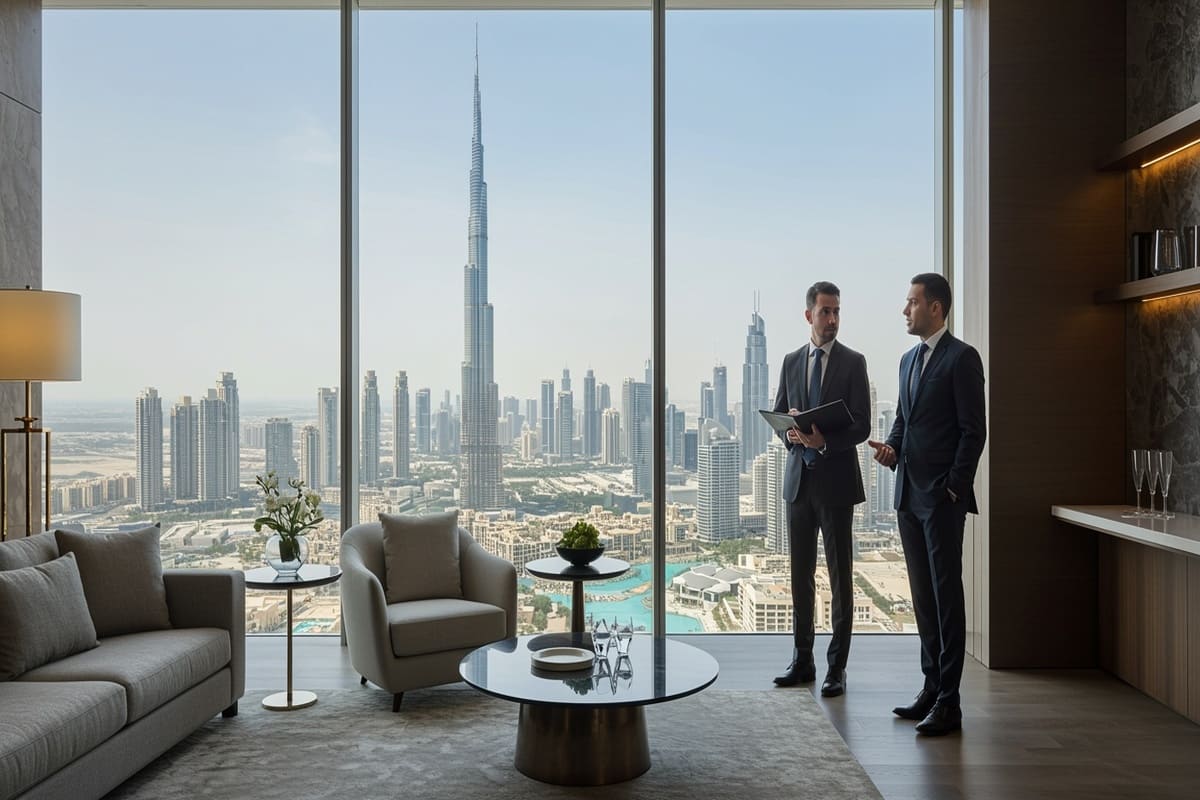
    The property marks a rare transaction at the very top of Dubai’s rental market, where high-net-worth tenants continue to commit to premium rents for scale, privacy, and prestige. The deal highlights how demand for trophy assets remains intact even as broader regional uncertainty persists.

    “In times of volatility, capital does not retreat, it becomes more selective. It seeks environments defined by stability, security, and long-term vision. Dubai continues to command that trust,” said Karl Haddad, owner of the property.

    A One-of-a-Kind Residence

    The residence stands apart within the Burj Khalifa itself, following a multi-year structural transformation that combined multiple units into a single vertical residence. The process took more than six years, including over three years of approvals, with concrete slabs modified to create a private internal staircase. The result is the only duplex of its kind in the tower.

    Spanning more than 10,000 square feet with plans to expand further, the property includes a large terrace, private pool, cinema, spa, and gym, alongside high-end finishes and custom interiors designed for long-term occupancy.

    “This property is unlike any other in the tower,” Haddad said. “On a personal level, this reinforces why I continue to invest and operate here. Dubai has built an ecosystem where ambition is protected, capital is respected, and confidence is sustained, even in the most testing moments.”

    Shift in Ultra-Prime Rental Demand

    The transaction was facilitated by Keyper and points to a shift in how ultra-wealthy residents approach property in Dubai.

    “Ultra-high net worth individuals are prioritising flexibility without compromising scale, privacy, or prestige. A Dh12 million annual lease would have been unthinkable just a few years ago. Today, it reflects the growing sophistication of Dubai’s ultra prime rental market.”

    Omar Abu Innab, Co-Founder and CEO of Keyper, noted that large-ticket property purchases remain common, though high-value leases at this level are still rare, placing the deal among a limited set of global transactions.

    That positioning has helped sustain activity in Dubai’s prime segment, even as other markets face slower deal flow. The flexible payment structures offered by landlords and the emirate’s strategic appeal continue to attract capital from ultra-high-net-worth individuals seeking stability and premium lifestyle offerings.

    The transaction comes as Dubai’s property market maintains resilience through ongoing regional tensions, with industry leaders citing structural advantages and a diversified buyer base as key factors supporting continued investor confidence across all segments.