Tag: Dubai real estate

  • Wasl Group Plans to Double Affordable Housing Portfolio by 2031

    Wasl Group Plans to Double Affordable Housing Portfolio by 2031

    Wasl Group currently manages one of Dubai’s largest affordable housing portfolios, comprising approximately 45,000 residential units across the emirate. These communities accommodate nearly 180,000 residents, over 90% of whom are families, positioning Wasl as a central player in supporting stable, community-driven living.

    The expansion plan follows a Memorandum of Understanding signed in May 2025 with the Roads and Transport Authority and Dubai Municipality. The coordinated effort will span a total planned area of 1.46 million square metres, with delivery phased over multiple stages to ensure infrastructure readiness and long-term community viability.

    Wasl’s current developments include Wasl Village in Al Qusais, which comprises about 6,200 residential units ranging from studios to three-bedroom apartments, and Wasl Green Park, offering around 2,527 units set within landscaped surroundings. Both projects exemplify the integration of affordability with quality urban living standards.

    The initiative directly supports the Dubai 2040 Urban Master Plan, which calls for a balanced housing ecosystem encompassing luxury, mid-income, and affordable segments. In August 2025, Dubai’s population crossed 4 million, with nearly 567 new residents settling in the emirate daily.

    The programme additionally advances the Dubai Economic Agenda D33, supporting workforce stability and economic productivity by diversifying housing supply amid the city’s rapidly growing population. With property market momentum continuing into 2026, the focus on affordable housing addresses a critical segment of market demand.

    Wasl’s developments are designed around connectivity, community infrastructure, greenery, and access to premium amenities, reflecting a commitment that quality living should be accessible across all income levels. The phased delivery approach aims to ensure infrastructure readiness and sustainable community development as the emirate’s residential market evolves.

  • Dubai Real Estate Sales Surge 18% to $16.5 Billion in February 2026

    Dubai Real Estate Sales Surge 18% to $16.5 Billion in February 2026

    Dubai’s real estate sector maintained exceptional momentum through February 2026, with transaction values climbing 18.14% year-on-year despite evolving market dynamics across property segments. According to Dubai Land Department data, total sales reached 16,959 deals generating AED60.60 billion ($16.5 billion), representing a 5% increase in volume compared to February 2025.

    Off-plan properties dominated market activity, accounting for 10,526 transactions or approximately 62% of total sales, while ready properties recorded 6,437 deals representing 38% of the market.

    Apartments Drive Residential Growth

    The apartment segment emerged as the primary growth driver, with transactions rising from 11,385 sales worth AED21.7 billion in February 2025 to 12,820 deals totaling AED26.6 billion in February 2026. The villa market experienced a sharp contraction, with transactions declining from 3,966 deals valued at AED19.7 billion to just 1,563 sales worth AED6.4 billion year-on-year.

    Commercial property demonstrated exceptional performance, with transactions surging from 443 sales valued at AED1.2 billion to 717 deals totaling AED9.54 billion—a near eight-fold increase in value.

    “Hitting over AED60 billion in sales volume solidifies Dubai’s position as one of the globe’s most resilient and desirable real estate hubs. This surge is driven by a balanced blend of end-user demand and enduring investor confidence,” said Tara Khan, Sales Director of Kelt and Co Realty.

    Khan noted that the market has reached a mature phase with steady price growth, strategically managed supply, and buyer involvement across both emerging and established communities.

    Transaction Activity Concentrated in Key Districts

    By volume, Jumeirah Village Circle led with 1,146 transactions, reaffirming its status as one of Dubai’s most active residential hubs. Al Yelayiss 1 followed with 916 deals, Madinat Al Mataar recorded 828 transactions, while Dubai Land Residence Complex registered 750 sales and Business Bay closed the top five with 733 deals.

    In value terms, Al Yelayiss 1 dominated with AED5.38 billion in sales, followed by Al Yelayiss 5 at AED2.41 billion and Me’Aisem Second at AED2.27 billion. Business Bay generated AED2.21 billion, while Palm Jumeirah reached AED1.89 billion, driven by continued demand for ultra-prime waterfront properties.

    Ultra-Luxury Transactions Define Upper Tier

    Among apartments, The Alba Residences by Omniyat topped the list with a AED225.97 million sale, followed by Peninsula Dubai Residences – Tower 2 at AED210 million. Solara Tower Dubai recorded a transaction worth AED113.66 million, while Passo by Beyond achieved AED98 million and Como Residences closed at AED63.5 million.

    In the villa segment, EOME at Palm Jumeirah led with a sale valued at AED115 million. Zaya Zuha Island at The World Islands featured multiple transactions at AED68.58 million, while Amali Island at The World Islands recorded a sale of AED68.4 million.

    The February performance follows Dubai’s landmark 2025, when the emirate’s population exceeded four million residents as property transactions approached Dh900 billion. The market has transitioned toward structured capital allocation, with strategic capital now accounting for approximately 40% of transactions.

    Market fundamentals remain supported by expanding business activity and tight inventory, particularly in the office sector where limited Grade A supply continues to drive investment activity across commercial segments.

  • DMCC Unveils 600-Metre Tower for Uptown District Phase 3

    DMCC Unveils 600-Metre Tower for Uptown District Phase 3

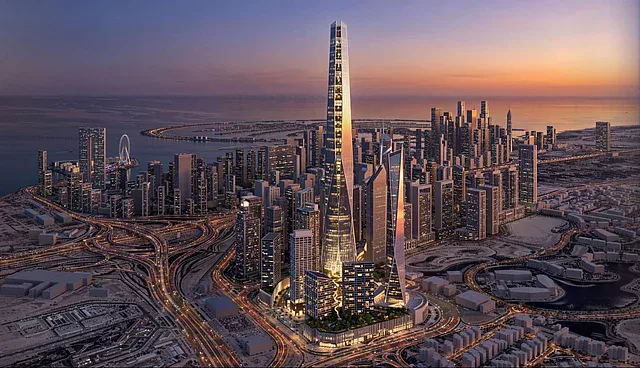
    The proposed megatall tower represents the latest expansion of DMCC’s strategic development in Dubai’s southern corridor, aligning with the emirate’s broader infrastructure transformation centered on Al Maktoum International Airport.

    Phase 1 of the Uptown District delivered the 340-metre Uptown Tower and central plaza. Phase 2, comprising two Grade A office towers and two residential towers, is under construction with completion scheduled for late 2027 and early 2028.

    Strategic positioning around future aviation hub

    Ahmed Bin Sulayem, Executive Chairman and Chief Executive Officer of DMCC, emphasized that the development responds to tangible market demand rather than speculative construction.

    “We build to meet the clear, growing requirements of a global trade community that is outgrowing its current footprint. The decision to develop the world’s largest airport in the southern corridor has broadened Dubai’s economic centre of gravity. Uptown District is the strategic anchor of this corridor.”

    The reference to structured capital allocation aligns with broader market trends as institutional investors prioritize strategic positioning over short-term gains.

    According to DMCC, approximately 50% of the tower’s space will be allocated to Grade A offices designed for multinational companies consolidating regional operations. The development will also include a luxury hotel operated by an international hospitality brand and high-end residential units.

    Smart infrastructure and connectivity

    The tower will incorporate smart-building systems and sustainability features, with direct integration to the Dubai Metro via a climate-controlled link bridge. Road infrastructure upgrades, including flyover access to Sheikh Zayed Road, are planned to support increased traffic capacity.

    DMCC stated the project targets continued demand from high-net-worth individuals relocating to Dubai, a trend reflected in recent market data showing sustained buyer interest across premium segments.

    The tower will feature a public viewing deck intended to attract visitors and serve as a vertical landmark for the district.

    Financial backing and market context

    DMCC confirmed that several major banks have expressed interest in partnering on the development, though specific financial details and timelines were not disclosed.

    Bin Sulayem described the development as part of creating “a sophisticated ecosystem where commerce and lifestyle are inextricably linked,” positioning the megatall tower as the district’s vertical anchor.

    The announcement comes as Dubai’s commercial property sector recorded Dh17.1 billion in sales during early 2026, with limited Grade A office supply in core business districts driving investors and corporates to secure prime space amid occupancy rates exceeding 95%.

    The planned expansion of Al Maktoum International Airport, set to accommodate 260 million passengers and 12 million tonnes of cargo annually, is reshaping development patterns across Dubai’s southern districts and reinforcing the strategic value of projects like Uptown District.

  • Dubai Real Estate Shifts from Speculation to Structured Capital Allocation

    Dubai Real Estate Shifts from Speculation to Structured Capital Allocation

    Strategic capital now drives approximately 40 percent of Dubai’s real estate market, according to a new report by VVS Estate, marking a fundamental shift from the momentum-based trading that characterized the 2014 cycle. This evolution reflects deeper regulatory oversight, improved transparency, and increasingly disciplined capital participation.

    “While property cycles are often described in terms of volatility and momentum, Dubai’s current evolution is structural in nature, shaped by regulatory depth, improved transparency and increasingly disciplined capital participation,” said Valentina Rusu, Founder of VVS Estate.

    High-Value Transactions Signal Long-Term Investment Behavior

    The proportion of residential transactions priced above Dh5 million has risen to 9 percent, reflecting sustained appetite for higher-value residential assets, according to Savills Middle East’s Dubai Residential Market Report 2025. Growth at the top end of the market typically indicates strategic capital deployment rather than short-term speculative activity.

    Off-plan transactions, widely viewed as a proxy for strategic capital allocation, account for over 60 percent of total residential transaction value, equivalent to approximately Dh223 billion, according to JLL data. Taken together with Savills’ pricing analysis, the figures point to a market increasingly shaped by deliberate allocation decisions.

    Property Finder insights show that premium and branded residences now represent a growing share of overall transactions. With a higher proportion of deals occurring above Dh2,500 per square foot, citywide averages have naturally moved higher.

    “This is not inflation. It reflects a segmentation shift. Comparing today’s market directly with 2014 without adjusting for product mix oversimplifies the analysis,” Rusu explained.

    Prices Surpass 2014 Peak Amid Structural Improvements

    Dubai reached its previous market peak in September 2014. A decade later, prices have not only recovered but surpassed those levels. According to the Dynamic Price Index published by Property Monitor, average apartment prices reached approximately Dh1,484 per square foot in early 2025, more than 20 percent above the 2014 high, before exceeding Dh1,600 per square foot by mid-2025.

    However, VVS Estate emphasizes that price recovery alone does not define market quality. “In 2014, growth was largely momentum-driven,” Rusu said. “Today, performance is supported by regulatory reinforcement, escrow discipline, standardized registration and improved execution transparency. The difference is structural.”

    Regulatory Frameworks Reduce Execution Risk

    One of the most consequential changes since the previous cycle has been the strengthening of regulatory frameworks under the oversight of the Dubai Land Department. Contract registration now operates within defined timelines through centralized systems, while escrow accounts follow milestone-based release mechanisms aligned with construction progress.

    “This regulatory depth has materially reshaped Dubai’s risk profile and increased its appeal to institutional and long-horizon capital,” Rusu noted.

    Investor behavior increasingly reflects disciplined capital allocation, with buyers focusing on net yields after service charges, resale comparables, supply-pipeline concentration, and developer delivery consistency. “Speculative markets depend on entry enthusiasm,” Rusu said. “Structured markets depend on exit depth.”

    The most significant change underway is behavioral rather than price-driven. Participation is shifting from excitement-led entry to allocation-driven decision-making, where capital is deployed strategically rather than reactively. Investors are increasingly viewing Dubai as a structured capital environment, defined by regulatory clarity, liquidity depth, and global positioning.

    The emirate’s property market continues to demonstrate strong fundamentals, with transactions nearing Dh900 billion as the population exceeded four million residents. Across the UAE, real estate growth remains robust, supported by infrastructure investment and economic diversification.

  • UAE Real Estate Records Strong 2025 Growth as Abu Dhabi Leads

    UAE Real Estate Records Strong 2025 Growth as Abu Dhabi Leads

    The year marked a defining period characterized by strong transactional activity, sustained developer confidence and policy-backed market growth. While all emirates recorded positive performance, Abu Dhabi emerged as a clear standout, supported by record sales volumes, rising end-user participation and growing international investor interest.

    Abu Dhabi Delivers Record Performance

    Abu Dhabi delivered one of its strongest residential real estate market performances on record in 2025, with transactions exceeding 21,000 units. Off-plan sales accounted for a growing share of activity, with 15,000 transactions, while completed unit sales reached nearly 6,000.

    The emirate added 7,000 residential units in 2025, complemented by record-breaking launch volumes that signal renewed developer confidence. Construction activity was further supported by the recommencement of several previously on-hold projects, particularly within established communities such as Al Reem Island.

    The year saw the highest concentration of branded and lifestyle-led development launches to date, many reaching sell-out status shortly after release. Separately, Abu Dhabi’s housing authority announced approximately 40,000 housing units and residential plots for UAE nationals.

    Leasing activity remained firmly positive, with high occupancy levels maintained across the Investment Zones. Prime and high-end apartments increased by 10 to 25 percent, depending on the community, while mid-quality apartments saw growth of 7 to 35 percent. The villa segment recorded average increases of 5 to 10 percent overall, with prime communities outperforming at 10 to 15 percent.

    The office market recorded its strongest performance in over a decade, driven by limited availability of premium space, corporate expansion and rising demand for flexible, high-quality workplaces. Several Grade A assets approached full occupancy, including Aldar’s Quartz Tower.

    Dubai Records Historic Completion Volumes

    Dubai remained a global focal point for real estate activity, recording the highest volume of residential completions in its history during 2025. The emirate delivered approximately 37,950 apartments and 9,700 villas, representing the highest residential delivery volume on record.

    The off-plan segment continued to underpin sales activity, supported by a steady flow of new launches and increasingly flexible payment structures. Well-positioned and competitively priced projects continued to perform strongly.

    In the rental market, growth moderated as affordability considerations became more prominent. The introduction of the Smart Rental Index in early 2025 played a pivotal role in guiding renewal negotiations, enhancing transparency and supporting a gradual stabilization of rental growth.

    The Dubai office sector continued its growth phase, characterized by substantial increases in demand, rising occupancy levels and rental rates, particularly for Grade A and well-located assets. Commercial supply was limited in 2025, with less than 280,000 square feet of office space delivered. However, new supply is expected to pick up significantly in 2026 with approximately 1.7 million square feet anticipated for handover.

    Northern Emirates Gain Momentum

    Across the Northern Emirates, 2025 saw accelerating development momentum and rising investor interest. A growing pipeline of residential, hospitality and mixed-use projects reflects improving confidence in the region’s long-term prospects, supported by government initiatives, infrastructure investment and tourism growth.

    Sharjah and Ras Al Khaimah continued to anchor activity, while Ajman recorded improving traction among both end-users and investors, supported by competitive pricing and improving project quality.

    Residential supply across the Northern Emirates is expected to become increasingly visible in 2026, as a growing number of developments transition into active handover phases. Approximately 12,900 residential units are forecast for completion, with delivery activity primarily concentrated in Sharjah, followed by RAK and Ajman.

    Policy Initiatives Support Market Growth

    Several major policy initiatives underpinned real estate market confidence throughout 2025. These include the continued implementation of formal rental index frameworks in Abu Dhabi, Dubai and Sharjah, the launch of Dubai’s First-Time Home Buyer Program in July 2025, ongoing housing initiatives in Abu Dhabi, continued regulatory reforms, digitalization of transactions and confirmation that Etihad Passenger Rail services are scheduled to commence operations in 2026.

    With 7,000 units scheduled for completion in Abu Dhabi and sustained delivery across Dubai and the Northern Emirates, the UAE real estate market is positioned for continued growth supported by disciplined development, policy frameworks and strong fundamentals.

  • GCC Real Estate Markets to Sustain Growth Momentum in H1 2026

    GCC Real Estate Markets to Sustain Growth Momentum in H1 2026

    Kuwait-based investment firm Markaz has released its Real Estate Outlook for H1 2026, forecasting sustained growth across GCC property markets despite evolving macroeconomic dynamics. The report identifies higher oil production, non-oil sector expansion, continued government infrastructure spending, and policy rate cuts as key drivers supporting borrowing and investment activity across residential, commercial, and industrial segments.

    UAE Market Expected to Peak in First Half

    The UAE real estate sector demonstrated exceptional performance through the first three quarters of 2025. In Dubai, transaction values surged 28.3 percent year-on-year to AED554.1 billion, while Abu Dhabi recorded AED58 billion in total sales—a remarkable 75.8 percent annual increase. Transaction volumes in the capital also climbed 42.3 percent to 15,800 deals.

    Dubai continues to offer compelling investment returns, with rental yields standing at 7.47 percent as of June 2025, significantly outperforming major global markets including Singapore, New York, and London. This aligns with recent data showing that long-term UAE renters are turning homeowners amid competitive pricing and flexible payment plans.

    While acknowledging concerns about market sustainability given three consecutive years of exceptional performance, Markaz emphasized that strong fundamentals reduce the likelihood of a sharp correction. The firm forecasts the UAE market could peak in H1 2026, characterized by steady growth in both prices and rental rates across Dubai and Abu Dhabi.

    The outlook reflects broader shifts in buyer behavior across the Gulf, with investors increasingly prioritizing developer credibility, rental yields, and long-term stability over speculative gains.

    Saudi Arabia Maintains Accelerating Phase

    Saudi Arabia’s real estate sector remained in an accelerating phase through H2 2025, propelled by robust residential activity and constrained office market conditions. Residential transactions increased 17.9 percent quarter-on-quarter in Q3 2025, with Riyadh and Jeddah leading price appreciation.

    The Kingdom’s office segment faces extreme supply constraints, with Riyadh vacancy rates near zero, supporting prime rent growth of 7.3 percent year-on-year. Demand stems from the Regional Headquarters Program and expanding healthcare and technology sectors.

    Despite a fiscal deficit projected at 3.7 percent of GDP for both 2025 and 2026, increased capital expenditure under Vision 2030 continues supporting construction activity. Saudi Arabia’s population reached 35.3 million by mid-2024, up 4.7 percent annually, with non-Saudis comprising 44.4 percent—a demographic dynamic that underpins sustained housing demand.

    Kuwait Shows Stable Growth Trajectory

    Kuwait’s real estate sector maintained steady growth through the first nine months of 2025, supported by rising land prices and rental rates. Total real estate sales increased 26.9 percent year-on-year to KWD3.043 billion, with transaction volumes up 27.8 percent to 4,247 deals.

    The investment segment led growth with a 60 percent annual increase in sales, while residential and commercial segments rose 8 percent and 17.4 percent respectively.

    Kuwait’s real GDP is projected to expand 3.9 percent in 2026, driven by higher oil production, improved non-oil activity, stronger project awards, and anticipated interest rate reductions. Based on a Markaz Real Estate Macro Index score of 3.45 out of 5.0, the firm expects Kuwait’s market to remain stable in H1 2026, with prospects for further increases in land prices and rental rates.

    The regional outlook comes as governments continue enhancing investor protection frameworks. Abu Dhabi recently launched mandatory digital registration for off-plan property interests through its Madhmoun platform, with funds secured in government-managed escrow accounts.

    Markaz emphasized that real estate will remain a key contributor to the GCC’s economic development in 2026, offering attractive opportunities for investors across all major property segments as the region’s markets continue to mature and evolve.

  • UAE Long-Term Renters Turn Homeowners Amid Flexible Payment Plans

    UAE Long-Term Renters Turn Homeowners Amid Flexible Payment Plans

    Competitive pricing compared to global cities, flexible payment plans, and residency incentives such as the Golden Visa are helping nudge more UAE residents towards home ownership, according to real estate experts.

    Blagoje Antic, CEO and Founder of DHG, noted strong interest in emerging, master-planned communities with a clear long-term vision, such as Meydan Horizon and Dubai Islands.

    “Looking ahead to 2026, demand is moving toward communities that balance accessibility with green spaces and a more sustainable way of living,”

    he said.

    The shift comes as buyer intent remains strong. Last month, a survey revealed that seven in 10 UAE residents plan to buy property in the next six months. The findings, based on Property Finder’s bi-annual Market Pulse survey, gathered responses from 5,540 participants and showed that buyers expect only moderate changes in prices.

    That intent is increasingly translating into actual purchases, supported by government-backed initiatives aimed at making home ownership more accessible. Dubai’s First-Time Home Buyer Programme has enabled more than 2,000 residents to purchase their first home in the past six months, generating over Dh3.25 billion in residential property sales, according to figures from the Dubai Land Department.

    Launched in July 2025 by the Dubai Department of Economy and Tourism and DLD, the programme offers first-time buyers priority access to new projects, tailored mortgage solutions and preferential pricing. More than 41,000 residents have registered for the programme so far, with nearly half of completed purchases made by residents who have lived in Dubai for more than five years without previously owning a home, highlighting its role in converting long-term renters into homeowners.

    Industry experts say this renewed confidence is drawing more first-time buyers and long-term residents into the market, with purchasers increasingly focused on build quality, location, developer reputation, and how well a home will hold up over time.

    “End users are more informed and are prioritising good layouts, practical design, amenities, and strong community infrastructure,”

    Antic said. “One- and two-bedroom apartments remain the most in-demand, mainly due to affordability and strong rental demand, with well-planned layouts and quality finishes playing a bigger role in decision-making.”

    Svetlana Vasilieva, Head of Secondary Sales at Metropolitan Premium Properties, said most first-time buyers currently have a budget range between Dh2 million and Dh3 million. She added that while some developers rarely offer incentives, others provide flexible payment plans or upfront discounts to encourage sales.

    “My advice to first timers is to buy with resale and long-term value in mind, not just what fits your budget today,”

    she said.

    Affordability and space remain key considerations.

    “Many first-time buyers are looking for larger apartments or townhouses within family-oriented communities and are willing to live further out to achieve a lower price per square foot,”

    Vasilieva added. In Dubai, buyers are most frequently enquiring about Arabian Ranches 3, The Valley, Dubai South, Nad Al Sheba and Town Square.

    Elie Namaan, CEO and Co-Founder of Ellington Properties, said market momentum is increasingly being driven by end-users buying with intent rather than urgency.

    “We have noticed far more confident and deliberate first-time buyers than even a year ago. These buyers are asking sharper questions and making decisions after more consideration, not just around price but around how a home fits into their daily life,”

    he said.

    Namaan added that livability has become central to the decision-making process, with buyers prioritising thoughtful layouts, natural light, storage, walkability and a sense of community over short-term gains.

    “There’s a growing recognition that a first home is not just a financial milestone, but an everyday environment that needs to support work, wellbeing and long-term comfort,”

    he said.

    The trend aligns with broader market shifts toward value-driven purchases across the region, as buyers prioritize developer credibility and long-term stability. With Dubai recording over 200,000 transactions in 2025 and residential prices rising 12.1%, the emirate continues to attract investors seeking quality and sustainable communities.

  • Gulf Property Buyers Shift to Value-Driven Approach in 2026

    Gulf Property Buyers Shift to Value-Driven Approach in 2026

    The Gulf property market is experiencing a fundamental shift in buyer behavior as 2026 unfolds. While transaction volumes remain robust, particularly in Dubai, the urgency that characterized late 2024 and much of 2025 has given way to careful, data-driven decision-making.

    Developers and sales leaders report that geopolitical uncertainty has sharpened buyers’ analytical skills without dampening demand. The UAE and wider Gulf continue to be viewed as stable environments for both residence and investment, but selectivity has become the defining characteristic of today’s market.

    From Speed to Strategy

    The most pronounced change is the transition from rapid purchasing to comprehensive due diligence. Donna Lee-Elliott, Chief of Sales at OCTA Properties, observed that buyers are increasingly favoring prime locations, reputable developers with proven track records, and projects underpinned by strong community fundamentals.

    Geopolitical headlines have not removed demand, but they have sharpened decision-making. Buyer sentiment in the first half of the year has shifted less towards hesitation and more towards disciplined selectivity.

    Enquiry levels in Dubai remain resilient, reflecting continued confidence in economic stability, infrastructure development, and regulatory transparency. However, purchasing behavior now emphasizes escrow compliance, construction-linked payment plans, and delivery certainty.

    Credibility and Clarity Drive Decisions

    Ahmed Hashish, Head of Sales at HRE Development, identified the growing emphasis on transparency as the market’s biggest transformation. “Buyers are still active, but they are more analytical,” he explained. “They are asking deeper questions about delivery timelines, build quality, long-term community value, and operating costs.”

    This scrutiny is creating market polarization. Strong projects with clear value propositions and proven track records continue to transact quickly, while projects lacking clarity face longer decision cycles and heavier negotiation.

    Demand is concentrating around established communities and well-planned lifestyle developments, while properties perceived as speculative or heavily reliant on short-term price appreciation are experiencing slower absorption.

    Safety and Predictability Attract Capital

    Heightened global uncertainty typically pushes investors toward stable, predictable assets—a pattern clearly visible across Gulf real estate markets. Ajay Rajendran, Founder and Chairman of Meraki Group, noted that buyers are gravitating toward established communities with proven demand through occupancy and resale activity.

    “When global uncertainty increases, buyers usually move toward what feels safe and predictable,” Rajendran said, adding that smaller apartments in well-connected locations and appropriately priced townhouses remain particularly active segments.

    This shift reflects broader movement toward practicality, with buyers focusing on liveability, long-term comfort, and sustainable service costs rather than speculative gains.

    Income Generation Over Trading

    A defining trend is the growing emphasis on income generation and long-term holding strategies. Investors are increasingly assessing realistic rental yields, service charges, and tenant demand before committing funds.

    Ammar Malhi, Chief Operating Officer at SmartCrowd, summarized the shift: “Buyers haven’t disappeared. They’ve just slowed down enough to think.” He noted that investors are focusing more on steady income than short-term price gains.

    Rental performance across Dubai remains strong, with many communities recording double-digit increases over the past two years, reinforcing the appeal of income-producing assets. Holding periods are extending while flipping activity has moderated as investors adopt longer time horizons.

    End-Users Shape Market Dynamics

    A rising share of transactions is being driven by end-users rather than short-term investors, particularly in lifestyle-led developments. Xu Ma, Founder and Chairman of Tomorrow World Properties, reported that owner-occupiers account for more than 85% of transactions.

    “Buyers are increasingly taking their time and prioritizing lifestyle and long-term fit over quick flips,” Ma said. Demand is strongest for larger homes, wellness-focused communities, and properties offering immediate move-in readiness.

    Investors remain active but are focusing more heavily on delivery credibility, rental demand, and long-term value retention.

    UAE Stability Supports Sustained Demand

    The UAE’s neutral geopolitical positioning remains a major factor attracting both people and capital to the property market. Relocation activity from Europe, South Asia, and North America continues to rise, driven by the country’s stable regulatory environment, business-friendly policies, and strong infrastructure.

    For many buyers, property ownership is tied to broader decisions around residency, lifestyle, and business continuity rather than purely financial returns. This combination of stability and opportunity is helping sustain demand even during periods of global volatility.

    Market Outlook

    Industry experts expect demand to remain resilient through the second half of 2026, though increasingly concentrated around high-quality assets. Prime residential developments, established communities, and projects with strong rental potential are likely to maintain momentum.

    Speculative or undifferentiated supply may face longer decision cycles, reflecting a maturing market where buyers prioritize fundamentals and long-term value over rapid gains. Major developers reporting record results continue to benefit from this flight to quality.

    The shift from urgency to analysis marks a healthy evolution in the Gulf property market, indicating growing sophistication among buyers and a more sustainable foundation for long-term growth.
  • Dubai Residential Prices Rise 12.1% as Market Records 200,000 Transactions

    Dubai’s property sector concluded 2025 with landmark performance metrics, recording over 200,000 sales transactions—an 18.8% increase over 2024—as both off-plan and ready property segments outperformed previous years, according to a report by Cavendish Maxwell.

    Residential prices rose 12.1% during the year, down from 16.5% growth in 2024, while rental increases moderated to 11-12% by year-end compared to 13-15% earlier in the year, signaling a gradual market stabilization.

    Off-Plan Dominance Intensifies Market Concentration

    Off-plan transactions represented 72.9% of total real estate activity in Dubai, up from 69.3% in 2024, with transaction volumes reaching 146,400 units—a 25% year-on-year increase. This surge was driven by sustained developer confidence and robust investor appetite for future developments.

    Ready property sales recorded more modest but steady growth, reaching 54,400 transactions, up 5% compared to 2024, supported by stable demand from end-users and investors seeking immediate occupancy opportunities.

    The market’s increasing reliance on off-plan sales, however, creates concentration risks, making it potentially vulnerable to shifts in launch momentum and buyer sentiment.

    Supply Dynamics Show Persistent Delivery Gaps

    Approximately 40,400 residential units were completed in 2025, significantly below the initial projection of 82,600 units, resulting in a materialization rate of just 48.9%. Despite falling short of targets, actual completions were 16.4% higher than the 34,700 units delivered in 2024.

    Looking ahead, around 110,500 residential units are projected for delivery in 2026, though historical completion patterns suggest actual deliveries may range between 33,000 and 50,000 units, with some projects likely spilling into 2027.

    Apartments are expected to dominate upcoming completions, representing 84.3% of projected units through 2028. Key locations including Jumeirah Village Circle, Dubai South, Business Bay, Dubai Residence Complex and DAMAC Lagoons are forecast to contribute 30.7% of all projected deliveries during this period.

    Luxury Segment Surges 47% in Transaction Volumes

    Dubai’s luxury real estate segment recorded approximately 2,500 transactions in 2025, marking a 47.1% increase compared to the previous year. Off-plan sales led growth with a 52.6% year-on-year increase, accounting for 70.5% of all luxury transactions.

    The ultra-luxury segment exhibited robust performance with 302 transactions totaling Dh27.9 billion, representing increases of 31.9% in volume and 53.7% in value compared to 2024, highlighting growing preference among high-net-worth individuals for Dubai as both a residential and investment destination.

    Economic Fundamentals Remain Supportive

    Despite emerging supply pressures, broader macroeconomic fundamentals continue supporting the market. UAE GDP growth is projected at 5.2% in 2026, with Dubai expected to expand by 4.5%, supported by ongoing infrastructure investment, population growth, and sustained tourism momentum.

    Tourism is projected to maintain momentum with visitor volumes expected to surpass prior-year levels, while business activity indicators remain positive, providing continued support across housing, retail and commercial sectors.

    Market Enters Transition Phase

    Looking ahead, Dubai’s real estate market is expected to remain relatively stable in 2026, though entering a critical transition phase where supply pressures, moderating growth trajectories and potential external headwinds require heightened vigilance.

    While a sharp correction appears unlikely given Dubai’s solid macroeconomic foundation, diversified economy and sustained population growth, stakeholders should prepare for a more balanced environment characterized by moderate appreciation and heightened selectivity.

    The market’s performance contrasts with record results posted by developers in 2025, suggesting continued confidence in long-term fundamentals despite near-term moderation signals.

  • Emaar Properties Reports Record 2025 Results with Dh80.4 Billion Sales

    Emaar Properties delivered its strongest financial performance to date in 2025, with growth accelerating across all business segments including property development, retail, hospitality, and international operations.

    The Dubai-based developer reported a 16% year-on-year increase in property sales to Dh80.4 billion ($21.9 billion), while total revenue climbed 40% to Dh49.6 billion ($13.5 billion). Net profit before tax rose 36% to Dh25.7 billion ($7 billion), and EBITDA reached Dh25.6 billion ($7 billion), marking a 33% increase from 2024.

    Revenue backlog surged 39% to Dh155 billion ($42.1 billion), providing substantial visibility on future earnings and demonstrating sustained market confidence.

    “Our 2025 results were shaped by a business environment that enables ambition and rewards long-term thinking. The UAE Government and the city of Dubai have created a framework built on stability, clear regulation, and openness to global investment, allowing companies like Emaar to plan with confidence, scale responsibly, and focus on execution,” said Mohamed Alabbar, Emaar founder.

    Domestic Development Drives Growth

    Emaar Development PJSC recorded Dh71.1 billion ($19.4 billion) in UAE property sales, representing a 9% increase from 2024. Revenue from domestic projects reached Dh36.4 billion ($9.9 billion), while net profit before tax grew an impressive 52% to Dh15.5 billion ($4.2 billion).

    The company launched 48 new residential projects throughout the year, including high-profile developments such as Grand Polo Club and Resort, The Valley, and Bristol at Emaar Beachfront. The UAE backlog stood at Dh134.3 billion ($36.6 billion), reflecting strong pre-sales momentum.

    These results align with broader market trends, as Dubai’s property sector continues its upward trajectory with record-breaking transaction volumes.

    International Expansion Accelerates

    International property sales experienced exceptional growth, surging 124% to Dh9.3 billion ($2.5 billion), with revenue of Dh2.6 billion ($0.7 billion) generated across operations in Egypt and India. This expansion demonstrates Emaar’s successful geographic diversification strategy beyond its home market.

    Recurring Revenue Streams Strengthen

    Emaar’s malls and retail leasing revenue increased 13% to Dh6.3 billion ($1.7 billion), maintaining an impressive 98% occupancy rate across its portfolio. The hospitality, leisure, and entertainment segment recorded revenue of Dh4.2 billion ($1.1 billion), up 12%, supported by higher tourism inflows and the addition of three new hotels.

    Combined recurring revenue from malls, hotels, and commercial leasing reached Dh10.5 billion ($2.8 billion), reflecting a 13% increase and strengthening the company’s diversified income base.

    The record performance comes as Dubai’s property market demonstrates exceptional momentum, with investor confidence remaining robust amid favorable regulatory frameworks and economic stability.

    Emaar’s 2025 results reinforce the company’s market leadership position and highlight the sustained appeal of Dubai real estate as a destination for both end-users and investors seeking long-term value in a transparent, well-regulated environment.