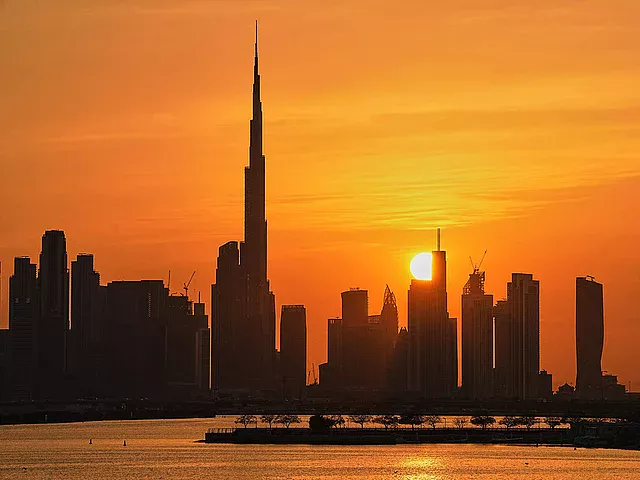
Dubai’s real estate sector continues to demonstrate operational stability as developers, brokers and analysts report sustained investor interest across prime locations and luxury developments, with transaction activity maintaining momentum through the first weeks of March 2026.
Firas Al Msaddi, chief executive of fäm Properties, emphasized the emirate’s track record of recovery following market disruptions. “I launched my company in Dubai in 2009 amid the global financial crisis, and have seen the market negotiate various geopolitical events since then,” he said. “Every single downturn in Dubai’s real estate history has been followed by a recovery that saw the market surpass the previous peak.”
Market data supports this pattern. Sales value in Dubai’s property market rose from Dh71.5 billion in 2020 to Dh686.8 billion in 2025, while prices climbed approximately 60% and transaction volumes increased sixfold, according to DXBinteract data.
Structural Advantages Support Demand
Tauseef Khan, founder and chairman of Dugasta Properties, noted that core demand remains steady particularly for prime and well-located assets. “While short-term caution may reduce speculative activity, core demand from both regional and international investors often remains steady,” he said.
Al Msaddi highlighted fundamental changes in market composition. “This moment is another test of Dubai’s resilience, and Dubai is well-equipped to pass the test again,” he said. “Over 70% of transactions are now end-user driven, not speculative. The buyer base is globally diversified, mortgage activity has doubled in four years, and the regulatory environment has matured.”
The shift toward cash buyers has strengthened market stability. “Last year there were 129 villa transactions above Dh40 million totalling Dh11.5 billion,” Al Msaddi said. “Only around 55 were mortgaged.”
Ultra-Prime Segment Shows Strength
The luxury property segment continues to process high-value transactions without significant price adjustments. Khan confirmed that several major deals have closed at full asking prices. “The closure of high-value deals at full price shows continued confidence in Dubai’s real estate fundamentals, even through regional uncertainty,” he said.
Abdullah Alajaji, founder and chief executive of Driven, Forbes Global Properties, noted that transaction evidence across prime and ultra-prime segments indicates stable pricing. “While opportunistic investors are actively screening for assets trading below intrinsic value, broad-based repricing has not been evidenced in current transaction data at this end of the market,” he said.
Macroeconomic Backdrop
The UAE’s strong fiscal position provides additional market support. S&P reaffirmed the country’s AA/A-1+ sovereign credit rating with a stable outlook in March 2026, highlighting consolidated net assets equivalent to 184% of GDP.
Alajaji attributed recent market volatility to geopolitical events rather than structural issues. “Recent volatility in oil prices and global markets is likely to be cyclical rather than structural, largely reflecting current geopolitical escalation,” he said.
Dubai’s economic diversification reduces direct correlation between oil prices and property demand, with non-oil sectors now accounting for approximately three-quarters of economic output.
Market Data Timeline
Industry experts cautioned that comprehensive impact assessment requires additional time. “Less than two weeks into the current conflict, it’s too early to give an overall assessment,” Al Msaddi said. “In real estate, transaction data takes 45 to 90 days to fully reflect actual sentiment from buyers, sellers and developers alike.”
Current market indicators suggest balanced conditions. “Buyer demand is steady across most price ranges,” Al Msaddi said. “Sellers are being patient, buyers are being selective but committed, and that balance is holding.”
The emirate’s regulatory framework continues to strengthen, with new building safety standards and shared housing regulations introduced in March 2026 to enhance market oversight and investor protection.
Khan said geopolitical developments often reinforce Dubai’s regional positioning over time. “Geopolitical developments can initially introduce a degree of caution among investors, particularly in the speculative segment of the market,” he said. “However, over time, they often reinforce Dubai’s position as a stable investment destination within the region.”