Tag: Dubai property market 2026

  • Dubai Records Dh422 Million Apartment Sale, Third Highest Ever

    Dubai Records Dh422 Million Apartment Sale, Third Highest Ever

    The luxury residential unit, located within the Aman Residences Dubai development by H&H Development, spans approximately 31,200 square feet (around 2,898 square metres) and includes six bedrooms and eight parking spaces, according to figures released by Dubai Land Department on Thursday.

    At an average price of roughly Dh13,525 per square foot, the transaction underscores sustained investor demand in Dubai’s ultra-prime property segment, even as heightened geopolitical tensions affect the broader region.

    The Dh422 million deal ranks behind only two other apartment sales in Dubai’s history. The emirate’s most expensive apartment sale was registered in 2025, when a unit at Bugatti Residences by Binghatti sold for Dh550 million. The second-most expensive transaction took place in 2023 at Como Residences, developed by Nakheel, where a unit changed hands for Dh500 million.

    The sale comes as Dubai’s property market recorded 16,959 transactions valued at AED60.60 billion in February 2026, with off-plan sales comprising 62% of total activity. The market’s performance reflects broader confidence in Dubai’s real estate fundamentals, supported by population growth that has recently surpassed four million residents.

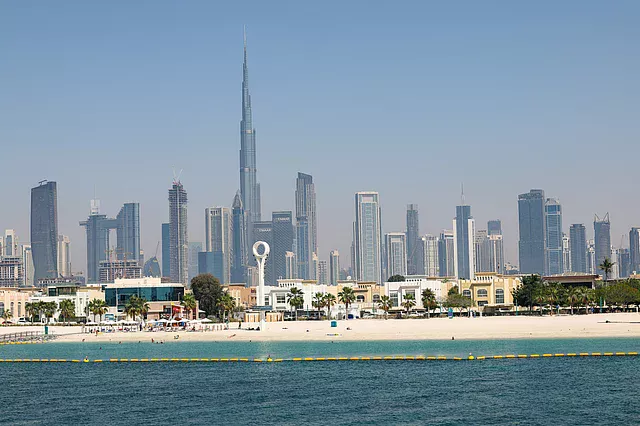
    Aman Residences Dubai is positioned within Jumeirah 2, one of the emirate’s established prime residential locations. The development caters to ultra-high-net-worth buyers seeking branded residences with premium amenities and services.

    The latest sale further underlines continued demand for high-end property in Dubai’s prime locations, reinforcing the emirate’s status as a leading destination for international real estate investment despite external market pressures.

    Dubai’s ultra-prime segment has consistently attracted buyers seeking stability, residency options including the Golden Visa programme, and exposure to one of the region’s most liquid property markets. The resilience demonstrated by this transaction suggests that investor confidence in Dubai’s long-term fundamentals remains strong, even as UAE property sales reached Dh17.2 billion in the first two months of 2026—a 118% increase year-on-year.
  • Dubai Real Estate Sales Surge 18% to $16.5 Billion in February 2026

    Dubai Real Estate Sales Surge 18% to $16.5 Billion in February 2026

    Dubai’s real estate sector maintained exceptional momentum through February 2026, with transaction values climbing 18.14% year-on-year despite evolving market dynamics across property segments. According to Dubai Land Department data, total sales reached 16,959 deals generating AED60.60 billion ($16.5 billion), representing a 5% increase in volume compared to February 2025.

    Off-plan properties dominated market activity, accounting for 10,526 transactions or approximately 62% of total sales, while ready properties recorded 6,437 deals representing 38% of the market.

    Apartments Drive Residential Growth

    The apartment segment emerged as the primary growth driver, with transactions rising from 11,385 sales worth AED21.7 billion in February 2025 to 12,820 deals totaling AED26.6 billion in February 2026. The villa market experienced a sharp contraction, with transactions declining from 3,966 deals valued at AED19.7 billion to just 1,563 sales worth AED6.4 billion year-on-year.

    Commercial property demonstrated exceptional performance, with transactions surging from 443 sales valued at AED1.2 billion to 717 deals totaling AED9.54 billion—a near eight-fold increase in value.

    “Hitting over AED60 billion in sales volume solidifies Dubai’s position as one of the globe’s most resilient and desirable real estate hubs. This surge is driven by a balanced blend of end-user demand and enduring investor confidence,” said Tara Khan, Sales Director of Kelt and Co Realty.

    Khan noted that the market has reached a mature phase with steady price growth, strategically managed supply, and buyer involvement across both emerging and established communities.

    Transaction Activity Concentrated in Key Districts

    By volume, Jumeirah Village Circle led with 1,146 transactions, reaffirming its status as one of Dubai’s most active residential hubs. Al Yelayiss 1 followed with 916 deals, Madinat Al Mataar recorded 828 transactions, while Dubai Land Residence Complex registered 750 sales and Business Bay closed the top five with 733 deals.

    In value terms, Al Yelayiss 1 dominated with AED5.38 billion in sales, followed by Al Yelayiss 5 at AED2.41 billion and Me’Aisem Second at AED2.27 billion. Business Bay generated AED2.21 billion, while Palm Jumeirah reached AED1.89 billion, driven by continued demand for ultra-prime waterfront properties.

    Ultra-Luxury Transactions Define Upper Tier

    Among apartments, The Alba Residences by Omniyat topped the list with a AED225.97 million sale, followed by Peninsula Dubai Residences – Tower 2 at AED210 million. Solara Tower Dubai recorded a transaction worth AED113.66 million, while Passo by Beyond achieved AED98 million and Como Residences closed at AED63.5 million.

    In the villa segment, EOME at Palm Jumeirah led with a sale valued at AED115 million. Zaya Zuha Island at The World Islands featured multiple transactions at AED68.58 million, while Amali Island at The World Islands recorded a sale of AED68.4 million.

    The February performance follows Dubai’s landmark 2025, when the emirate’s population exceeded four million residents as property transactions approached Dh900 billion. The market has transitioned toward structured capital allocation, with strategic capital now accounting for approximately 40% of transactions.

    Market fundamentals remain supported by expanding business activity and tight inventory, particularly in the office sector where limited Grade A supply continues to drive investment activity across commercial segments.

  • Dubai Real Estate Shifts from Speculation to Structured Capital Allocation

    Dubai Real Estate Shifts from Speculation to Structured Capital Allocation

    Strategic capital now drives approximately 40 percent of Dubai’s real estate market, according to a new report by VVS Estate, marking a fundamental shift from the momentum-based trading that characterized the 2014 cycle. This evolution reflects deeper regulatory oversight, improved transparency, and increasingly disciplined capital participation.

    “While property cycles are often described in terms of volatility and momentum, Dubai’s current evolution is structural in nature, shaped by regulatory depth, improved transparency and increasingly disciplined capital participation,” said Valentina Rusu, Founder of VVS Estate.

    High-Value Transactions Signal Long-Term Investment Behavior

    The proportion of residential transactions priced above Dh5 million has risen to 9 percent, reflecting sustained appetite for higher-value residential assets, according to Savills Middle East’s Dubai Residential Market Report 2025. Growth at the top end of the market typically indicates strategic capital deployment rather than short-term speculative activity.

    Off-plan transactions, widely viewed as a proxy for strategic capital allocation, account for over 60 percent of total residential transaction value, equivalent to approximately Dh223 billion, according to JLL data. Taken together with Savills’ pricing analysis, the figures point to a market increasingly shaped by deliberate allocation decisions.

    Property Finder insights show that premium and branded residences now represent a growing share of overall transactions. With a higher proportion of deals occurring above Dh2,500 per square foot, citywide averages have naturally moved higher.

    “This is not inflation. It reflects a segmentation shift. Comparing today’s market directly with 2014 without adjusting for product mix oversimplifies the analysis,” Rusu explained.

    Prices Surpass 2014 Peak Amid Structural Improvements

    Dubai reached its previous market peak in September 2014. A decade later, prices have not only recovered but surpassed those levels. According to the Dynamic Price Index published by Property Monitor, average apartment prices reached approximately Dh1,484 per square foot in early 2025, more than 20 percent above the 2014 high, before exceeding Dh1,600 per square foot by mid-2025.

    However, VVS Estate emphasizes that price recovery alone does not define market quality. “In 2014, growth was largely momentum-driven,” Rusu said. “Today, performance is supported by regulatory reinforcement, escrow discipline, standardized registration and improved execution transparency. The difference is structural.”

    Regulatory Frameworks Reduce Execution Risk

    One of the most consequential changes since the previous cycle has been the strengthening of regulatory frameworks under the oversight of the Dubai Land Department. Contract registration now operates within defined timelines through centralized systems, while escrow accounts follow milestone-based release mechanisms aligned with construction progress.

    “This regulatory depth has materially reshaped Dubai’s risk profile and increased its appeal to institutional and long-horizon capital,” Rusu noted.

    Investor behavior increasingly reflects disciplined capital allocation, with buyers focusing on net yields after service charges, resale comparables, supply-pipeline concentration, and developer delivery consistency. “Speculative markets depend on entry enthusiasm,” Rusu said. “Structured markets depend on exit depth.”

    The most significant change underway is behavioral rather than price-driven. Participation is shifting from excitement-led entry to allocation-driven decision-making, where capital is deployed strategically rather than reactively. Investors are increasingly viewing Dubai as a structured capital environment, defined by regulatory clarity, liquidity depth, and global positioning.

    The emirate’s property market continues to demonstrate strong fundamentals, with transactions nearing Dh900 billion as the population exceeded four million residents. Across the UAE, real estate growth remains robust, supported by infrastructure investment and economic diversification.