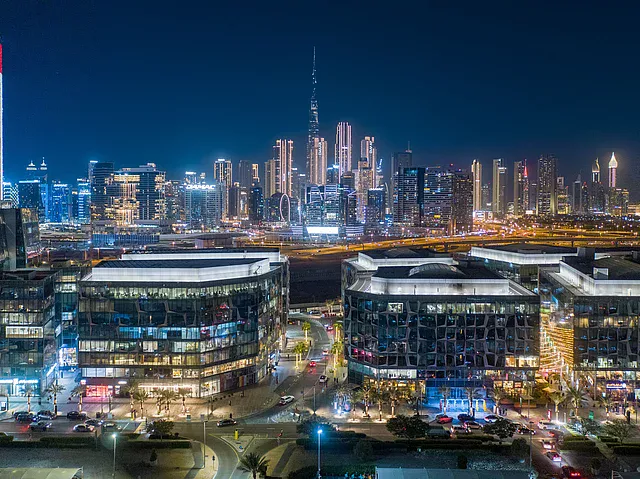
Dubai’s commercial real estate market is experiencing exceptional momentum in 2026, driven by acute shortages of premium office space in central business districts. Fresh data from Engel & Völkers Middle East reveals that commercial sales reached Dh17.1 billion across 1,446 transactions, representing an 82% value increase and 23.7% volume growth compared to the previous year.
The office segment has emerged as the standout performer, with transaction volumes surging 133% year-on-year and total sales values jumping 296%. This unprecedented activity reflects intense competition for limited Grade A inventory in prime locations including DIFC, Downtown Dubai, and Business Bay.
“Dubai’s office market is experiencing one of its tightest supply environments in recent history, driven by strong business formation, relocation of multinational firms and continued expansion in financial and technology sectors,” said Taimur Khan, head of research for MENA at CBRE.
According to Cavendish Maxwell, Dubai’s office sales more than doubled to Dh13.1 billion in 2025, marking the strongest performance in over a decade with transaction volumes rising 53% to approximately 4,600 deals.
Property consultancy CBRE has highlighted that occupancy levels in prime office buildings across central locations have exceeded 95%, pushing rents upward and prompting firms to secure space well ahead of completion. Limited new completions over the next two years are expected to keep vacancy rates low and support continued rental and capital value growth in prime assets.
The supply constraint has accelerated activity in the off-plan commercial segment, with primary market transactions accounting for 41.3% of total commercial deals in the latest period, signaling growing appetite among investors and end-users to secure future office inventory before completion.
Jayakrishnan Bhaskar, CEO of Ozon Marketing Management, emphasized that the office segment has been the standout performer, with investors and corporates increasingly committing earlier in the development cycle to secure space amid tightening availability.
Meanwhile, Dubai’s residential sector continues to perform strongly, though entering a more mature growth phase. The emirate recorded 15,981 residential sales transactions, up 20.8% year-on-year, with total sales value climbing to Dh55.9 billion, a 55.3% increase highlighting a shift toward higher-value purchases and premium locations.
Dubai saw more than 1,000 residential transactions above Dh10 million in January alone, one of the strongest monthly performances on record. Demand has been supported by established luxury addresses such as Palm Jumeirah and Nad Al Sheba, as well as emerging high-end communities including Palm Jebel Ali, The Oasis, and Jumeirah Golf Estates 2.
Average gross rental yields across apartments and villas have strengthened to approximately 6.9%, reinforcing Dubai’s appeal for income-focused investors. However, while residential prices continue to rise, the pace of growth is moderating compared with sharp increases seen between 2023 and 2025.
V.S. Bijukumar, a Dubai-based property consultant, noted that the evolving residential landscape reflects a maturing market characterized by longer holding periods and a growing preference for buy-to-stay and yield-focused strategies rather than short-term speculative activity.
“In commercial real estate, the acceleration in office transactions and values reflects tightening Grade A availability, driving a strategic shift towards the off-plan market as corporates and investors seek to secure long-term positioning. These dynamics reinforce Dubai’s status as a market defined by depth, liquidity and resilience,” said Daniel Hadi, chief executive of Engel & Völkers Middle East.
Industry experts indicate that Dubai’s economic expansion, population growth exceeding 4 million, and rising inflow of global companies and high-net-worth individuals continue to underpin demand across real estate segments. The emirate’s positioning as a regional headquarters hub for multinational corporations and a magnet for entrepreneurs and investors is expected to sustain pressure on prime office supply in the near term.