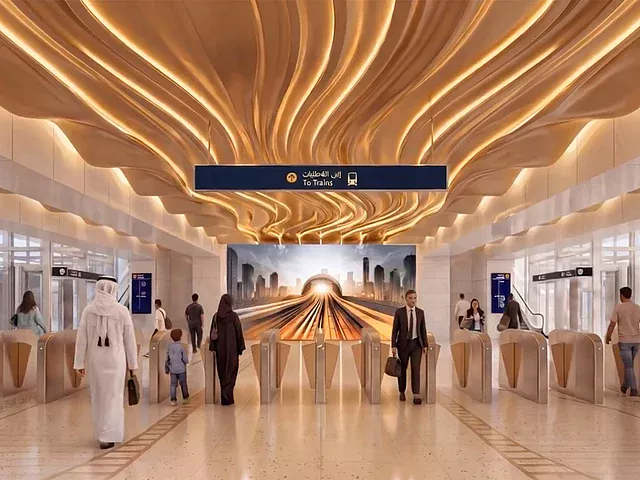
The planned Gold Line is beginning to influence the investment case for some of Dubai’s busiest residential districts, with brokers and developers expecting the biggest lift in communities where property demand has grown faster than public transport access.
The Dh34 billion fully underground metro line will connect 15 strategic locations through 18 stations, placing Jumeirah Village Circle, Mohammed Bin Rashid City, Meydan, Al Barsha South, Business Bay and Jumeirah Golf Estates among the areas likely to draw stronger buyer attention over the next few years.
The line is not scheduled to open until September 2032, but Dubai’s property market rarely waits for infrastructure to be completed before pricing it in. Route announcements, confirmed station locations and visible construction tend to move buyer behaviour well ahead of opening day, especially in areas where future transport access can change daily commutes, rental demand and resale liquidity.
“The Dubai Metro Gold Line is not simply a transport upgrade; it is a value creation event, and the real estate market will respond accordingly.”
Mohammed Al Sari, Chief Development Officer at HRE Development, said the market will respond to the value creation opportunity. That explains why JVC, MBR City and Meydan are drawing the most attention. These are already active residential and investment corridors, but each has carried a connectivity gap that the Gold Line could help close.
The Connectivity Gap Starts to Close
JVC has long been one of Dubai’s highest-volume residential markets, supported by relatively accessible pricing, strong apartment supply and deep tenant demand. Its missing piece has been direct metro access.
MBR City and Meydan have a different profile, with premium positioning, master-planned development and proximity to central Dubai, but they too have relied heavily on road connectivity. Al Barsha South sits between the two categories, an established mid-market community with stronger future potential once linked more directly to the city’s transport network.
Issa Atiq, CEO of Arabian Acres, said communities gaining metro access for the first time will see the greatest impact, particularly MBR City, JVC and Al Barsha South.
Rohit Bachani, Co-Founder of Merlin Real Estate, expects Business Bay, Nad Al Sheba, Jumeirah Golf Estates and surrounding districts to benefit, with improved connectivity supporting both end-user demand and investor interest.
The strongest value creation is likely to sit near stations and interchange points. Business Bay’s connection with the Red Line, Al Ghubaiba’s link with the Green Line, and planned links with Etihad Rail at Meydan and Jumeirah Golf Estates could make these nodes more valuable than the wider corridor.
Ajay Rajendran, Chairman and Founder of Meraki Developers, said the strongest accessibility premium is likely around interchange stations, where multiple transport lines meet and daily connectivity improves most clearly.
Developers Are Already Reading the Signal
Infrastructure announcements in Dubai tend to change development strategy before they change passenger movement. Developers review land values, reposition future launches and adjust layouts around the kind of buyer expected to enter the market once connectivity improves.
That process has already started along the Gold Line corridor. Land acquisition is accelerating in some locations, while off-plan projects in Meydan and MBR City are being evaluated around future metro proximity. The logic is that a buyer purchasing today for handover several years later is not only buying the current neighbourhood, but the version of that neighbourhood expected to exist when the transport network catches up.
Nithin Chauhan of Pride & Property said developers with land along the corridor are moving faster on feasibility because infrastructure backing makes the development case easier to close.
The response is also expected to influence the type of homes brought to market. Developers are likely to place greater focus on mid-market and lifestyle-led homes for commuters, along with higher-rise and mixed-use formats in transit-oriented zones. Walkability, last-mile access and integrated retail are likely to become more central to project design because the Gold Line buyer will be looking for convenience, not only location.
How Much Can Prices Rise?
Dubai’s previous metro-linked communities offer a guide, though the uplift will not be uniform. Station proximity, product quality, launch pricing, handover timing and developer credibility will decide which projects capture the strongest premium.
Several market participants point to historical premiums of around 20% to 30% for metro-adjacent properties in Dubai, with values often moving during the construction phase before services begin. Al Sari said properties near Dubai metro stations have typically commanded premiums of 20% to 30%, with values rising 18% to 25% during development phases.
“That pricing response tends to begin early, and we are at that inflection point now.”
Atiq also expects demand to be strongest within walking distance of interchange stations. Villa communities may still benefit, but the uplift is likely to be more modest than in apartment-heavy or mixed-use districts where public transport plays a larger role in daily life.
Chauhan’s estimate is slightly more conservative, placing the historical metro adjacency premium at around 15% to 20% for comparable units in Dubai. Even at that level, the aggregate impact could be significant if the premium applies across part of a corridor linked to more than 50 major developments.
Transactions Could Move in Waves
The Gold Line’s full impact is expected to unfold over several years. Dubai property markets typically reprice infrastructure in stages, starting with the announcement, then route clarity, visible construction, the 12 to 24 months before opening and the post-launch period when tenants and residents begin using the network.
Rajendran expects a comparable response along the Gold Line, with some pockets likely to perform more strongly because they already have established demand.
The Gold Line corridor starts from a stronger base than many emerging infrastructure stories. JVC already has high transaction volumes. MBR City and Meydan already attract investors. Business Bay is already one of the city’s most liquid districts. The metro line adds a new reason for buyers to act, but it does not have to create demand from scratch.
Chauhan said infrastructure announcements tend to pull forward buyer decisions, especially when investors have more clarity around future access. Bachani expects a multi-year lift in both off-plan and resale activity as the project progresses and station locations become clearer.
A Wider Investment Map
The Gold Line’s importance lies in how it expands Dubai’s property map. Communities that were previously judged mainly on road access will now be assessed through a future metro lens. That can improve liquidity, widen the tenant pool and make some areas more attractive to long-term end-users.
Bachani said the Gold Line will be a strong catalyst for specific corridors and communities, with its real contribution coming from “widening Dubai’s investment map” and creating new demand pockets over time.
The wider economic case is also significant. The RTA projects a 430% cumulative economic return over 20 years, while property values near stations are forecast to rise by up to 20%. With 55 major developments already connected to the corridor and a catchment of around 1.5 million residents, the real estate multiplier is likely to be one of the most closely watched parts of the project.
Atiq said the Gold Line stands apart because it will actively shape areas that are still developing, instead of only serving fully established districts. “That is a more powerful value creation model, and the window to enter before the market reprices is now,” he said.
The Gold Line development follows recent momentum across Dubai’s expanding property market, where mega-projects continue to reshape investment priorities and price dynamics across key communities.