Tag: commercial real estate Dubai

  • Dubai Off-Plan Sales Drive $10.18 Billion Residential Market in April

    Dubai Off-Plan Sales Drive $10.18 Billion Residential Market in April

    Dubai’s residential sector maintained stable activity levels through April despite a more measured global investment environment, with transaction values increasing 0.46% compared to March 2026.

    Off-Plan Segment Accounts for AED28.55 Billion

    Off-plan activity remained the primary driver of market performance during the month, recording 9,990 transactions worth AED28.55 billion and representing 76.39% of total transaction value. The segment continues to benefit from demand for newly launched communities, phased payment structures, and infrastructure-led residential development.

    Dubai’s market performance through April once again reinforced the strength of the city’s long-term fundamentals. Despite broader geopolitical uncertainty, liquidity remained healthy, transaction activity held steady and investor participation across key residential corridors continued to reflect confidence in Dubai’s long-term growth trajectory.

    Farooq Syed, CEO of Springfield Properties, emphasized sustained confidence despite regional challenges.

    Secondary Market Records 3,072 Transactions

    Dubai’s secondary real estate market contributed AED8.83 billion across 3,072 transactions, with activity concentrated in established residential communities supported by end-user demand and long-term ownership confidence.

    Residential activity remained concentrated across several key master-planned communities. Dubai South recorded the highest transaction volume with 1,140 deals, followed by Jumeirah Village Circle with 797 transactions and Dubai Islands with 693 transactions. DAMAC Lagoons and Dubai Creek Harbour also maintained healthy activity levels.

    Pricing Holds Firm Across Segments

    Residential pricing remained broadly firm during April. Off-plan apartments averaged AED2,111 per square foot, while off-plan villas reached AED2,293 per square foot. Secondary villas maintained premium positioning at AED2,406 per square foot, reflecting sustained demand for completed family-oriented communities.

    Properties priced between AED1 million and AED3 million represented 53.62% of transactions with recorded sale values, while higher-value segments above AED5 million maintained stable activity levels.

    Commercial Sector Records AED10.35 Billion

    Beyond residential, Dubai’s commercial real estate market recorded AED10.35 billion across 963 transactions during April. Office transactions alone accounted for AED3.34 billion across 428 deals, reinforcing occupier and investor demand across established business districts and mixed-use commercial corridors.

    The report noted that recent updates to Dubai’s property-linked residency requirements are expected to support broader market participation over the medium term, particularly across affordable and mid-market residential segments.

    Dubai continues to strengthen its position as a global destination for capital, business and long-term residency. What differentiates the market today is not only resilience, but also the consistency of the city’s long-term vision, infrastructure investment, regulatory clarity and ability to sustain confidence through changing global conditions.

    Syed concluded that activity levels are expected to remain supported by population growth, strategic development, and sustained international demand across both residential and commercial sectors as market conditions continue to stabilize.

    The April figures align with broader market trends documented across the first quarter of 2026, when Dubai’s property sales exceeded Dh180 billion, reinforcing the emirate’s position as a global real estate destination.
  • Dubai Real Estate Sales Cross Dh180 Billion in Q1 2026

    Dubai Real Estate Sales Cross Dh180 Billion in Q1 2026

    The emirate’s real estate sector delivered exceptional performance between January and March 2026, with residential sales accounting for Dh143.1 billion across 44,743 transactions—a 22.2% increase compared to the same period last year—while commercial transactions reached Dh37.9 billion from 3,619 deals, according to Engel & Völkers Middle East.

    The standout feature of the quarter was the sharp rise in high-end activity, with 2,148 property transactions valued above Dh10 million representing one of the highest quarterly totals on record. Several landmark deals illustrated investor appetite at the ultra-prime level, including a Dh422 million off-plan residence at Aman Residences, a Dh350 million villa at Jumeirah Asora Bay, and a Dh340 million villa on Jumeirah Bay Island.

    “Dubai’s real estate market continues to demonstrate exceptional depth, particularly at the luxury end, where demand remains highly resilient,” said Daniel Hadi, chief executive of Engel & Völkers Middle East. “What we saw in March was a natural pause linked to evolving regional conditions, but also a transition towards a more mature phase where buyers and investors are increasingly focused on value, quality and long-term fundamentals.”

    Prime demand remained concentrated in established communities such as Palm Jumeirah and Dubai Hills Estate, while master-planned destinations including The Oasis Dubai and Nad Al Sheba gained traction alongside emerging waterfront developments such as Palm Jebel Ali and La Mer.

    The commercial property sector mirrored the broader market’s strength, with office assets emerging as a standout performer. A total of 1,565 office transactions were recorded during the quarter, representing a 74.5% increase year-on-year, while average office prices rose to Dh3,047 per square foot as demand strengthened for Grade A workspaces.

    Business hubs such as Business Bay, Al Sufouh and Dubai Maritime City accounted for a significant share of off-plan office activity, reflecting continued expansion by multinational companies and professional services firms establishing regional headquarters in the emirate.

    Official figures from Dubai Land Department reinforced the strength of the broader trend, showing total real estate transactions reached Dh252 billion in the first quarter of 2026, a 31% increase year-on-year across more than 60,000 deals. Foreign investment alone climbed 26% to Dh148.35 billion, highlighting sustained international confidence despite regional volatility.

    Although the market entered the year with strong momentum, activity became more measured toward the end of the quarter following regional tensions in late February, with some buyers extending decision-making timelines. However, analysts describe this as a temporary adjustment in sentiment rather than a structural slowdown in demand.

    The emirate’s population growth remains a key structural driver of demand, with Dubai’s resident base surpassing four million last year as professionals, entrepreneurs and investors continue relocating under long-term residency programmes and business-friendly policies.

    With rental yields still averaging between 6% and 8% in many communities and total property sales already reaching a record Dh686.8 billion in 2025, the strong start to 2026 suggests Dubai’s real estate sector is entering a more selective and globally institutional phase. The first-quarter performance reflects Dubai’s growing appeal to global high-net-worth individuals seeking secure assets, residency advantages and long-term lifestyle investments.

  • Dubai Office Prices Jump 29% Amid Prime Asset Shortage

    Dubai Office Prices Jump 29% Amid Prime Asset Shortage

    Average office sales prices in Downtown Dubai climbed 29% year-on-year to Dh5,130 per square foot in 2025, according to the latest market review by Knight Frank, underscoring strong demand for well-located income-generating assets in one of the region’s most dynamic commercial real estate markets.

    The rally has been accompanied by a sharp rise in high-value transactions. A total of 167 office deals worth more than Dh10 million were recorded last year, marking a 114% increase from 2024 and signalling deepening institutional and private investor confidence in Dubai’s long-term economic trajectory.

    “Dubai’s office market has firmly established itself as one of the most dynamic and resilient in the region. The near-tripling in Dh10 million-plus transactions between 2023 and 2025 underscores the depth of capital targeting Dubai and reflects strong belief in the city’s economic and real estate fundamentals,” said Faisal Durrani, partner and head of Research, MENA at Knight Frank.

    The surge in values reflects tightening availability of high-quality stock as businesses expand their regional presence and upgrade workplace environments to attract talent. Companies are increasingly willing to pay premiums for efficient floorplates in well-connected districts with strong lifestyle amenities and metro access.

    Adam Wynne, partner and head of Commercial Agency, UAE at Knight Frank, said occupancy levels across prime office buildings remain close to full capacity. “Demand continues to outpace supply, which has driven both capital values and rents higher quarter-on-quarter and year-on-year — a trend that has persisted since 2020,” he noted.

    The strength of the market is being driven largely by the banking, financial services and technology sectors, which together accounted for more than half of new office space requirements during the second half of 2025. Banking and finance represented 32.5% of demand, while technology firms accounted for 23.1%, reinforcing Dubai’s position as a regional hub for innovation and global capital flows.

    This shift towards premium workspace is also widening the performance gap between modern Grade-A buildings and older secondary stock, with blue-chip occupiers increasingly favouring single-owned institutional-grade developments over strata-titled properties.

    Despite the strong price momentum, a substantial pipeline of new supply is expected to reshape the market over the medium term. Around 24.2 million square feet of office space is scheduled for delivery between 2026 and 2030, largely concentrated in core business districts such as Business Bay, Meydan City, Jumeirah Lake Towers and the Dubai International Financial Centre (DIFC).

    DIFC alone has a long-term pipeline of 7.7 million square feet planned through to 2040, reinforcing its status as the region’s leading financial hub and a magnet for international banks, asset managers and professional services firms.

    Knight Frank said the upcoming supply is strategically aligned with occupier demand and is expected to moderate price growth over time, supporting a more balanced market environment rather than reversing the current upward trend.

    Business Bay stands out as a key investment hotspot, with its entire under-construction pipeline designated as build-to-sell stock, offering investors direct exposure to one of Dubai’s fastest-growing commercial districts. Meanwhile, emerging locations such as Za’abeel are attracting attention from occupiers seeking central connectivity at relatively competitive rents, currently averaging around Dh550 per square foot.

    Looking ahead, analysts expect the office market to remain tight in the short term until new developments begin entering the pipeline in meaningful volumes.

    “Once the next wave of supply is delivered, we expect a greater divergence between Grade-A rents and secondary assets. Blue-chip occupiers remain focused on well-managed, single-owned buildings, especially within free zones,” Wynne said.

    With strong demand from finance and technology firms, rising investor appetite and limited availability of prime stock, Dubai’s office sector is emerging as one of the most resilient segments of the emirate’s commercial real estate market. The trend mirrors broader momentum across commercial property prices, which have demonstrated sustained growth despite regional challenges.

    The office market surge comes as Dubai’s property market shows resilience across multiple sectors, reinforcing the emirate’s role as a global business hub at a time of continued economic expansion.

  • DIFC Delivers 600,000 Sq Ft Office Project Ahead of Schedule

    DIFC Delivers 600,000 Sq Ft Office Project Ahead of Schedule

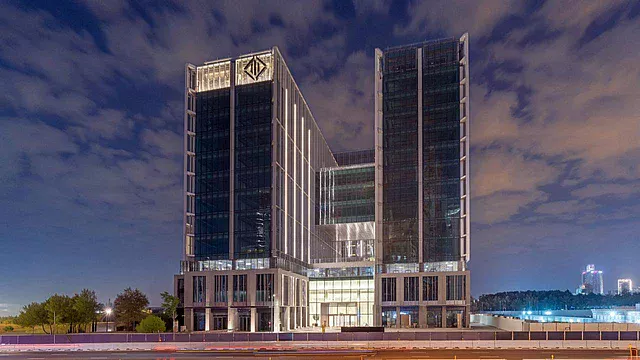
    The completion of DIFC Square marks a significant milestone in Dubai’s commercial real estate sector, responding to unprecedented demand from multinational corporations expanding their regional operations. The three-building glass-façade complex was delivered within an accelerated 24-month design-and-construction timeline.

    Several prominent financial institutions and professional services firms have secured space in the development, including Bank of Singapore, Deutsche Bank, Gallagher Insurance, Herbert Smith Freehills Kramer, Moody’s, and TP ICAP. Some companies are relocating to larger premises within the complex, while others are expanding their footprint by taking additional space.

    “Financial centres of the future focus on innovation, being sustainable, digitally inclusive and customer centric. At DIFC, we are ensuring that all our real estate projects align with this vision, while playing a critical role in ensuring the quality of life that attracts and retains global talent in Dubai as a top four global financial centre,” said Saleh Al Akrabi, Chief Real Estate Officer at DIFC Investments.

    Tenants who have already received their offices have begun fit-out works, according to DIFC. The relocation of existing tenants into DIFC Square is expected to create 100,000 square feet of additional capacity in the centre’s Gate District and Gate Village, which remain among the most sought-after office locations within the financial hub.

    The development includes dedicated parking and retail spaces, with several dining outlets set to open in the complex, including Duck and Rice, Saddle, Hudson and Rye, Liban, and Cakes and Bubbles.

    DIFC Square forms part of the centre’s wider expansion plans to deliver 1.6 million square feet of commercial space in 2026 and 2027. Upcoming projects include DIFC Living, Innovation Two, and Immersive Tower.

    The new development has been built to LEED standards, with certification by the US Green Building Council expected soon. The completion comes as commercial property sales surged 82% in early 2026, driven by limited Grade A office supply in core business districts.

    Dubai’s office market has demonstrated exceptional strength over the past year, with sales values reaching Dh13.1 billion in 2025—more than doubling from 2024 in the strongest performance in over a decade—as occupancy rates in premium locations exceed 95%.